BS 5839-1:2025Current
Fire alarm systems in non-domestic buildings
Have your system serviced by a competent person at least every six months.
What BS 5839-1 means for you →Established in Hull in 1992 — Fire & Security Systems Across Yorkshire, Lincolnshire & the Humber
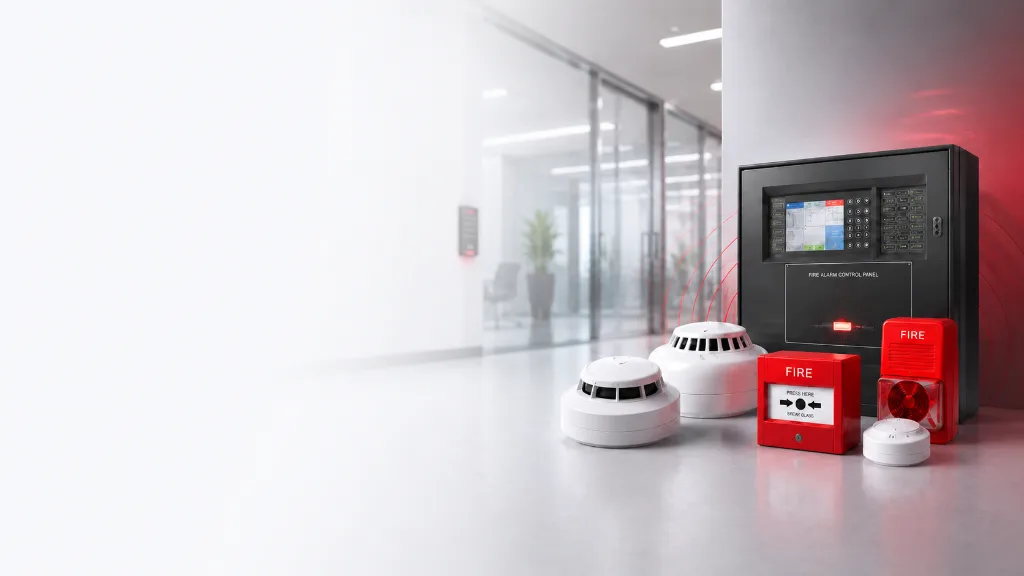
Engineers designing and installing fire detection and alarm systems for commercial, industrial and multi-site premises across Yorkshire, Lincolnshire and the Humber, to BS 5839-1:2025 and BAFE SP203-1.
SPS Technical is a commercial fire alarm installer designing and installing fire detection and alarm systems for commercial, industrial, education and public sector premises across Yorkshire, Lincolnshire and the Humber. Our engineers are FIA-trained and BAFE SP203-1 accredited — the recognised UK benchmark for fire alarm installation and maintenance. Every installation begins with a site survey and fire risk assessment review, and ends with a BAFE SP203-1 certificate of compliance and full as-fitted documentation.
Not all fire alarm systems are equal. Conventional systems suit smaller, straightforward buildings. Addressable systems are the standard for most commercial premises, offering pinpoint detection at device level. Open protocol systems protect clients from contractor lock-in by using manufacturer-independent protocols that any competent BAFE-accredited installer can maintain. SPS Technical installs open protocol systems as standard and audits existing systems for proprietary lock-in during takeovers.
System types
Choosing the right fire alarm system
Not all fire alarm systems are equal. The right system depends on your building size, occupancy, fire risk assessment and long-term maintenance strategy.
Conventional systems
Best for: smaller or straightforward buildings
Addressable systems
Best for: most commercial buildings
Open protocol systems
Best for: avoiding contractor lock-in
Why open protocol matters
Many businesses inherit fire alarm systems that can only be serviced by the original installer. Proprietary systems use manufacturer-specific protocols that lock you into one supplier regardless of price or service quality. SPS Technical installs open protocol systems as standard — meaning you're never locked in, and any competent BAFE-accredited contractor can maintain your system. When taking over existing systems, we audit whether the system is open or proprietary and advise on migration options.
BS 5839 classifies fire alarm systems by their protection objective. Category L systems protect life through early warning to occupants. Category P systems protect property by detecting fire early enough to trigger ARC response before the building is seriously damaged. Most commercial premises require a combination of both — the appropriate categories are determined by the fire risk assessment, which SPS Technical reviews during the site survey.
Compliance
BS 5839 system categories
BS 5839 classifies fire alarm systems by protection objective. The correct category is determined by your fire risk assessment — not by what is cheapest or most convenient to install.
Category L — Life protection
Protecting occupants through early warning
Common in offices, schools, care homes and public buildings
Category P — Property protection
Early detection to limit damage and trigger ARC response
Common in warehouses, unoccupied premises and high-value facilities
Our process
SPS Technical follows a structured installation process for every fire alarm project — from initial site survey through to BAFE SP203-1 certification. No system is handed over without full cause-and-effect testing, ARC connection verification and complete documentation.
Site Survey
Premises assessed for occupancy, layout, escape routes and existing fire safety measures. Fire risk assessment reviewed.
System Design
System category, detector types and placement specified to BS 5839-1. Panel, sounder and ARC signalling designed.
Installation
Structured cabling, device mounting, panel installation and ARC signalling equipment fitted.
Commissioning
Full cause-and-effect testing, zone verification and ARC connection established. Every device confirmed.
Certification
BAFE SP203-1 certificate issued. Full documentation provided including as-fitted drawings and system records.
Site Survey
Premises assessed for occupancy, layout, escape routes and existing fire safety measures. Fire risk assessment reviewed.
System Design
System category, detector types and placement specified to BS 5839-1. Panel, sounder and ARC signalling designed.
Installation
Structured cabling, device mounting, panel installation and ARC signalling equipment fitted.
Commissioning
Full cause-and-effect testing, zone verification and ARC connection established. Every device confirmed.
Certification
BAFE SP203-1 certificate issued. Full documentation provided including as-fitted drawings and system records.
Integration
A fire alarm system rarely operates in isolation. In most commercial buildings it must interface with access control door releases, emergency lighting, smoke extraction, HVAC and ARC monitoring. SPS Technical installs and maintains all of these system types, which means integration is designed correctly from the outset and tested at every maintenance visit.
A fire alarm system rarely operates in isolation. SPS Technical designs and installs fire detection alongside access control, emergency lighting, HVAC and ARC monitoring — ensuring the building responds as a coordinated system when fire is detected.
Access Control
Automatic door release on alarm activation. Electric locks fail-safe to open, ensuring evacuation routes are clear.
ARC Monitoring
Fire alarm signal transmitted to an Alarm Receiving Centre (ARC). 24/7 monitoring and escalation per your agreed response protocol.
Emergency Lighting
Interface tested at every maintenance visit. Lighting activates on alarm to support safe evacuation.
Smoke Control & HVAC
Ventilation systems shut down or switch to smoke control mode on alarm activation.
Lifts
Lift recall to ground floor on fire alarm activation, preventing use of lifts during evacuation.
Suppression Systems
Interface with sprinkler and gas suppression systems for high-risk environments.
Accreditation
BAFE SP203-1 is the recognised UK scheme for the design, installation, commissioning and maintenance of fire detection and alarm systems. Certification is independently assessed — it is not self-declared. Choosing a BAFE SP203-1 accredited contractor provides verifiable, third-party confirmation that your fire alarm work has been carried out to the recognised standard. This supports your insurance obligations, satisfies regulatory requirements and provides a defensible audit trail if your fire safety arrangements are ever scrutinised.
Standards that apply
The British Standards and laws we work to, in plain English. Each one links to a summary page with the current edition and the official source.
Have your system serviced by a competent person at least every six months.
What BS 5839-1 means for you →Know who the Responsible Person is for each of your premises.
What the Fire Safety Order means for you →Any access-controlled door on an escape route should release automatically when the fire alarm operates.
What BS 7273-4 means for you →Ask the Standards Library. Answers come only from our library and quote their sources.
Try one of these:
Answers come only from our standards library and quote their sources. They are general guidance, not advice for a specific building, and are produced automatically, so check the source before relying on them. Please don't include names or personal details in your question.
Editions checked 12 October 2026 by the SPS Technical team.
FAQs
Knowledge Centre

A practical guide to commercial fire alarm monitoring: how ARC signalling works, when monitoring may be appropriate, response arrangements, testing and maintenance.

A practical guide to commercial fire alarm beeping, panel faults, detector chirps and warning conditions — including when to call an engineer.

A practical guide to commercial fire alarm testing frequency, including weekly user checks, professional servicing intervals, logbooks and BS 5839-1 maintenance.
We'll arrange a site survey and provide a clear, itemised quote, with no obligation.
Accreditations
Independently certified, working to British Standards. Check every accreditation on the official register.
Registration HUMB018
Intruder alarms to PD 6662, CCTV to SSAIB Code of Practice SS2003, access control to SS2002, and fire alarm systems
Verify at ssaib.orgCertificate 104302 · Organisation ID 303286
Fire alarm design, installation, commissioning and maintenance to BS 5839-1
Verify at bafe.org.uk1208-QMS-001 · 1208-EMS-001
Quality and environmental management, certified by Alcumus ISOQAR. ISO 9001 held since 1997
CHAS-0004703 · Constructionline 92018 · SafeContractor PE5040
SSIP health and safety approval, procurement registration and Paxton Gold Installer status
For intruder alarms, SPS Technical is an approved installer of police-response systems with the following forces, so your intruder alarm can be issued a police Unique Reference Number (URN) under the NPCC Police Requirements for Security Systems.
Police approval applies to intruder alarms only.
Since 1992
Established in Hull
1,750+
Systems maintained
2,850+
Scheduled service visits a year
4
Regional offices: Hull, Grimsby, Lincoln, Sheffield
Trusted across universities, NHS and healthcare, local authorities, schools and academy trusts, logistics and industrial sites, transport, and stadiums and venues.
Reviewed by the SPS Technical team · Last updated October 2026
Full accreditation details