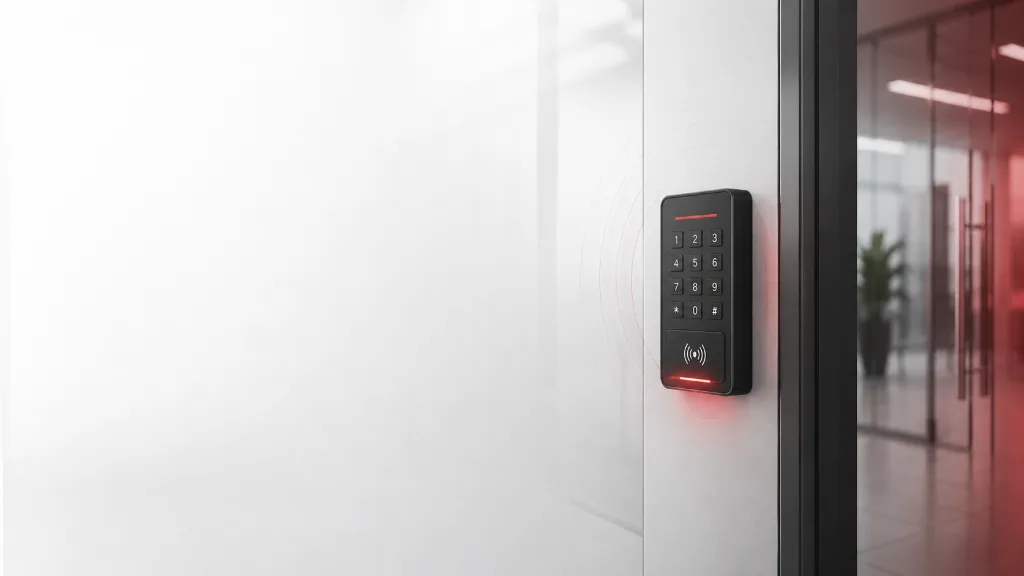
How an Access-Controlled Door Works
Every access-controlled door is made of the same few parts. Tap each one to see what it does, and what happens when the fire alarm sounds or the power goes off.
Interactive door
The eight parts of an access-controlled door
Tap a number on the door, or a part in the list, to see what it does.
Part 1
Reader
Checks the fob, card, phone or PIN, and asks the controller whether this person may open this door now.
Fire and power
Fail safe or fail secure?
Every locked door is set to do one of two things when the power fails. We agree which for each door at survey.
Fail safe (fail unlocked)
Unlocks when the power fails or the fire alarm sounds.
Used for: Escape routes and fire exits
Fail secure (fail locked)
Stays locked when the power fails, with a mechanical key override.
Used for: Store rooms and cash offices, never an escape route
Credentials
Fob, card, phone, PIN or biometric?
A credential is how a person proves who they are at the door: something they have, something they know or something they are.
Fob or card
Best for
Most staff doors
Watch out for
Can be lent or lost, so remove leavers promptly
Phone
Best for
Staff who always carry a phone, and remote sites
Watch out for
Needs the app set up on each phone
PIN
Best for
Adding a second check to a fob
Watch out for
Codes get shared if used on their own
Biometric
Best for
High-security rooms
Watch out for
Higher cost, and personal data rules apply
FAQs
Door and credential questions
Planning new doors?
Book a free survey and we'll design the right access control for each door.
Accreditations
Why trust SPS Technical
Independently certified, working to British Standards. Check every accreditation on the official register.
SSAIB
Registration HUMB018
Intruder alarms to PD 6662, CCTV to SSAIB Code of Practice SS2003, access control to SS2002, and fire alarm systems
Verify at ssaib.orgBAFE SP203-1
Certificate 104302 · Organisation ID 303286
Fire alarm design, installation, commissioning and maintenance to BS 5839-1
Verify at bafe.org.ukISO 9001 and ISO 14001
1208-QMS-001 · 1208-EMS-001
Quality and environmental management, certified by Alcumus ISOQAR. ISO 9001 held since 1997
Safety and procurement
CHAS-0004703 · Constructionline 92018 · SafeContractor PE5040
SSIP health and safety approval, procurement registration and Paxton Gold Installer status
Police-response intruder alarms
For intruder alarms, SPS Technical is an approved installer of police-response systems with the following forces, so your intruder alarm can be issued a police Unique Reference Number (URN) under the NPCC Police Requirements for Security Systems.
- Humberside Police
- Lincolnshire Police
- North Yorkshire Police
- South Yorkshire Police
- West Yorkshire Police
- Nottinghamshire Police
- Derbyshire Constabulary
- Greater Manchester Police
Police approval applies to intruder alarms only.
Since 1992
Established in Hull
1,750+
Systems maintained
2,850+
Scheduled service visits a year
4
Regional offices: Hull, Grimsby, Lincoln, Sheffield
Trusted across universities, NHS and healthcare, local authorities, schools and academy trusts, logistics and industrial sites, transport, and stadiums and venues.
Reviewed by the SPS Technical team · Last updated October 2026
Full accreditation details