Free Online Tool · CCTV Systems
Free CCTV Health Check
Check whether your CCTV system is recording correctly, retaining footage for long enough and providing useful images where they matter most.
The result is an indicative assessment based on the information provided. It does not replace a professional CCTV survey or certify system performance or legal compliance.
About this tool
The SPS Technical CCTV Health Check is a free online assessment for commercial CCTV users. It asks non-technical questions about recording, footage retention, camera suitability, maintenance, access security and privacy management. It produces an indicative health score, potential concerns and recommended next steps. It does not certify system performance or legal compliance.
Designed for facilities managers, estates teams, responsible persons and business owners. SPS Technical provides commercial fire and security design, installation, maintenance and monitoring across Yorkshire, Lincolnshire and the Humber.
Start Your Free CCTV Health Check
Answer a few straightforward questions about your CCTV system. You can select “I don’t know” where technical information is unavailable.
This assessment reviews:
CCTV is most effective when it has a clearly defined purpose. This health check helps you review whether your system appears suitable for what you expect it to do. It is an indicative assessment and does not replace a professional site survey.
This online CCTV health check is based on the information you supply and provides an indicative result only. It does not certify system performance, legal compliance, image suitability or evidential quality. Pixel-density (DORI) estimates are planning indicators and do not guarantee that a person or object will be identifiable. Storage estimates are based on selected or assumed settings.
This tool provides an initial indication only. Results are based on the information you have provided and recognised industry standards. They are not a substitute for a site-specific technical assessment, insurer advice or formal compliance review. Maintenance requirements may vary depending on system type, site conditions, monitoring arrangements, certification status and insurer requirements. SPS Technical can confirm the correct requirements following a review of your system.
What Does the CCTV Health Check Assess?
The assessment reviews six connected areas of a CCTV system. Each area receives its own score and explanation in your results.
Recording and playback
Checks whether live and recorded images are available, whether footage can be played back and whether recordings can be exported when needed.
Footage retention
Compares how long you need footage to remain available with the oldest footage currently stored on your recorder.
Camera suitability
Reviews whether important camera views may provide enough detail for their intended purpose using recognised visual-detail principles.
Maintenance condition
Looks for signs of deterioration such as blurred images, dirty lenses, damaged cameras, warning messages and repeated faults.
Access and security
Reviews basic controls around passwords, individual user accounts, remote access and former users.
Privacy and management
Considers signage, access to footage, documented purpose, retention arrangements and responsibility for the system.
What Is a CCTV Health Check?
A CCTV health check is a structured review of whether a video surveillance system is operating as expected and remains suitable for the purpose for which it was installed.
A camera displaying a live image does not necessarily mean the whole system is healthy. The camera may be blurred, obstructed or poorly positioned. The recorder may have insufficient storage. Footage may not be available for the required period, or users may discover during an incident that recordings cannot be exported.
A useful CCTV health check therefore looks beyond whether cameras are switched on. It considers recording, playback, footage retention, image detail, maintenance, user access and system management. For ongoing upkeep, see our commercial CCTV maintenance and servicing.
What Is DORI in CCTV?
DORI is a commonly used way of describing the amount of visual detail that a CCTV camera may provide. It stands for:
- Detection — seeing that a person or object is present.
- Observation — seeing what is happening and identifying broad characteristics.
- Recognition — potentially recognising somebody who is already known.
- Identification — potentially capturing sufficient detail to support identification.
The calculation considers how many image pixels cover the width of the scene. A wide camera view spreads the available pixels across a larger area, while a more focused view places more pixels on the important subject. DORI is a useful planning indicator, but it does not guarantee that a person will be identifiable. Lighting, movement, camera angle, lens quality, image compression, weather, focus and installation quality can all affect the real result.
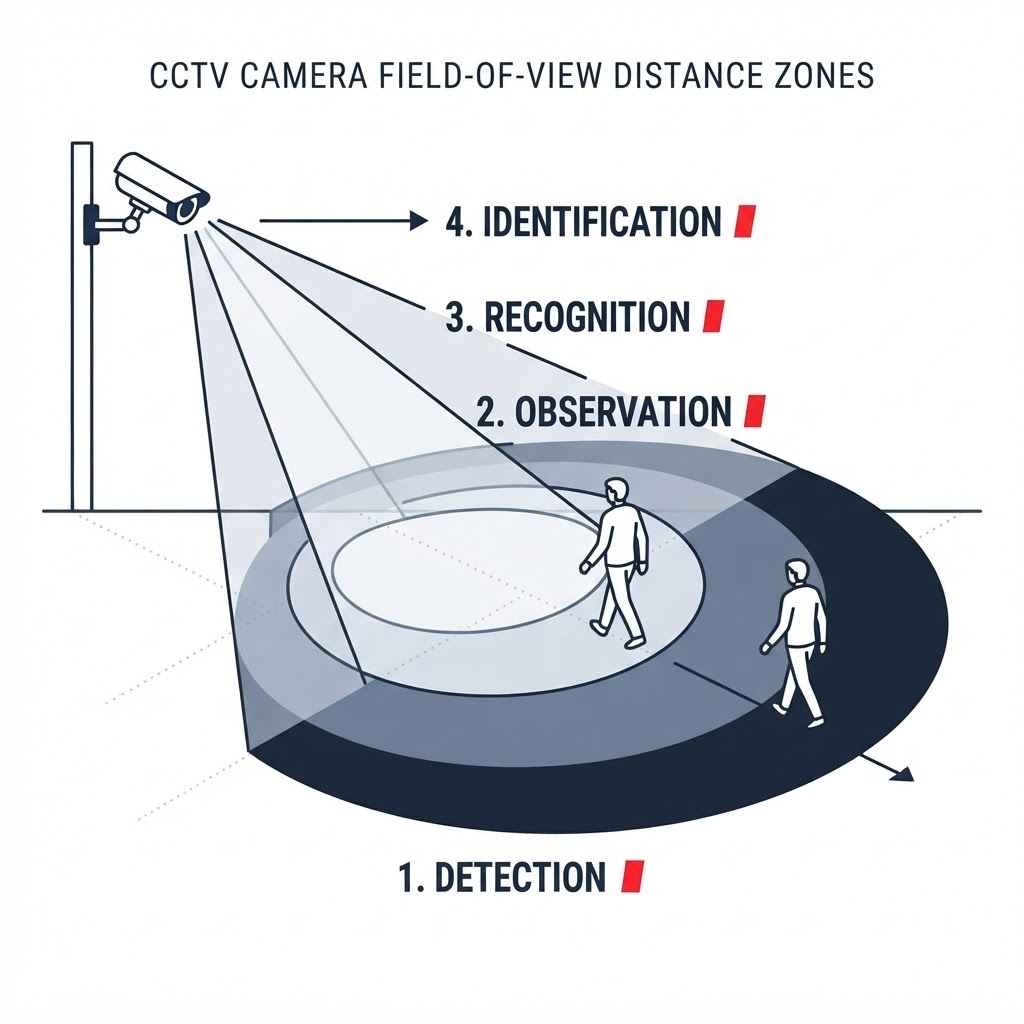
Wide view · less detail → more detail
What Should a CCTV System Do?
CCTV can help organisations:
- monitor important locations
- review incidents after they occur
- observe entrances, exits and operational areas
- support staff and visitor safety
- verify reported events
- provide recorded information
- support wider security procedures
- deter some unwanted activity
CCTV should not be treated as:
- a guarantee that crime will not occur
- a replacement for physical security
- a replacement for staff procedures
- a substitute for suitable lighting
- permission to monitor areas without justification
- a guarantee that every person will be identifiable
- a system that can be installed and then ignored
- a reason to retain recordings indefinitely
CCTV performs best when each camera has a clearly defined purpose and the system is regularly tested, maintained and reviewed.
Why Can CCTV Performance Decline Over Time?
CCTV systems can gradually become less effective even when no major failure has been reported. Cameras may be moved, lenses can become dirty, vegetation or new fixtures may block views, lighting conditions may change and recording settings may be altered.
Additional cameras or higher-resolution settings can also reduce the number of days of footage stored if recorder capacity is not increased.
How Is the CCTV Health Score Calculated?
The result combines six separate areas: recording, retention, camera suitability, maintenance, access security and privacy management.
Each section receives its own score and explanation. Important faults, such as being unable to retrieve footage or a recorder reporting a storage failure, are highlighted separately and may override an otherwise positive average.
The score is based on the answers supplied by the user. Unknown answers reduce the confidence of the assessment rather than being treated automatically as a failure.
Recording and playback
Carries the greatest weight — unavailable footage is the most serious issue.
Footage retention
Weighted to reflect the operational need to retrieve recordings.
Camera suitability
Reflects whether important views meet their intended purpose.
Maintenance condition
Considers visible deterioration and recent servicing.
Access and security
Reviews basic credential and access controls.
Privacy and management
Considers signage, documentation and responsibility.
The result should be used as a starting point for further investigation, not as a certificate of system condition.
How Long Should CCTV Footage Be Retained?
There is no single retention period that is correct for every CCTV system. The appropriate period depends on the purpose of the system, how quickly incidents are normally discovered, operational requirements and the organisation’s documented data-retention approach.
Footage should generally not be kept for longer than is necessary for the defined purpose. Organisations should be able to explain why their chosen retention period is appropriate.
This tool compares the period the user says they require with the oldest footage currently available. A shortfall may indicate insufficient storage, changes to recording settings, additional cameras or a recorder fault.
Related guidance: CCTV maintenance, CCTV system design, CCTV monitoring and compliance guidance.
When Should You Arrange a Professional CCTV Review?
Any of the following suggests a professional review is worthwhile:
Recognise any of these issues?
Request a CCTV System ReviewWhy Choose SPS Technical for CCTV Maintenance and System Reviews?
SPS Technical supports commercial organisations with CCTV design, installation, maintenance, monitoring and system improvement.
Our approach looks at the complete operational requirement rather than simply confirming that a camera displays an image. We consider recording, footage retrieval, image suitability, storage, maintenance condition and how the system is used in practice.
Where this online health check identifies a concern, SPS Technical can provide a professional review and explain the available remedial options.
CCTV Health Check FAQs
Is the CCTV Health Check free?
Yes. The online assessment is free to complete and provides an immediate indicative result.
Do I need technical CCTV knowledge?
No. The questions are written for business owners, facilities managers and other non-technical users. Select “I don’t know” where information is unavailable.
Does the result certify that my CCTV system is compliant?
No. The result is an indicative assessment based on the answers provided. It does not certify legal compliance, system performance or evidential image quality.
What does DORI mean?
DORI stands for Detection, Observation, Recognition and Identification. It describes different levels of visual detail that a CCTV image may provide.
Can a working camera still be unsuitable?
Yes. A camera may show a live image but still be blurred, obstructed, poorly positioned or unable to provide the detail required for its intended purpose.
How often should a CCTV system be serviced?
The suitable maintenance frequency depends on the system, operating environment, risk and contractual requirements. Regular inspection helps identify faults and deterioration before footage is needed.
Why is my CCTV footage retention shorter than expected?
Possible causes include insufficient storage, failed drives, additional cameras, changes to resolution or frame rate, continuous recording or altered recorder settings.
Does CCTV prevent crime?
CCTV may deter some activity and support incident investigation, but it cannot guarantee that crime or other incidents will not occur.
Can SPS Technical review the results?
Yes. Users can request a professional CCTV review after completing the assessment.
Want a Professional to Verify Your Findings?
Complete the health check above, then request a professional CCTV review from SPS Technical. We can confirm the findings on site and explain any remedial options.