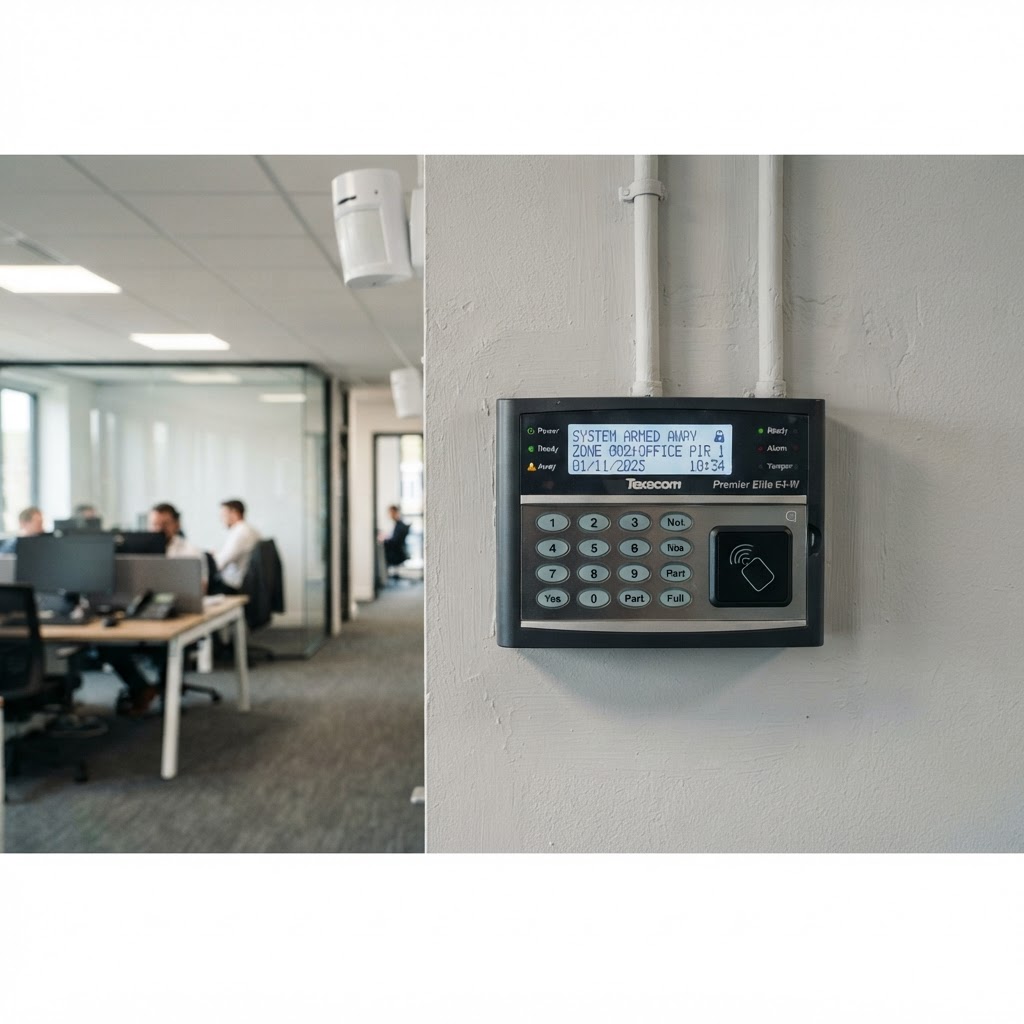
A commercial intruder alarm should do more than make a noise after somebody has entered your building.
For a business or facilities manager, the right system starts with the risk: what needs protecting, how someone could gain access, when the premises is most vulnerable, how quickly an intrusion needs to be verified and what response should follow.
That can lead to a very different solution for a small office than for a warehouse containing high-value stock, a manufacturing site with multiple access points, or a multi-site estate that needs centrally managed monitoring.
Modern commercial intruder alarms can combine perimeter detection, door contacts, movement detectors, signalling, remote monitoring and confirmation technology. They can also form part of a wider security strategy alongside CCTV, access control, lighting, physical security and keyholding.
This guide explains the main choices facilities managers should understand before specifying, replacing or taking over a commercial intruder alarm system.
Important: Security systems should be designed around the actual premises and risk. Insurer, police-response and other stakeholder requirements can affect the specification. Always confirm those requirements before changing an existing system or commissioning a new one.
What is a commercial intruder alarm system?
A commercial intruder alarm system — sometimes searched for as a commercial burglar alarm — is an electronic security system designed to detect unauthorised entry or activity and initiate an appropriate warning or response.
A typical system can include:
- control and indicating equipment;
- keypads or other setting/unsetting devices;
- door and window contacts;
- passive infrared (PIR) movement detectors;
- dual-technology detectors;
- glass-break or vibration detection;
- external detection;
- internal and external sounders;
- alarm transmission equipment;
- remote monitoring;
- confirmation technology; and
- interfaces with other security systems.
The correct combination depends on the building and its risk.
A system for a low-risk office should not simply be copied into a high-value distribution centre. Equally, buying the most complicated equipment available does not automatically create better security.
The objective is a proportionate, reliable system that detects the right events and produces the right response.
Start with the risk, not the alarm panel
One of the easiest mistakes when replacing an alarm is to start with equipment.
A better specification starts by understanding the site.
Ask:
- What assets are we protecting?
- What would the operational impact of a break-in be?
- Where are the likely points of entry?
- Is the building isolated outside working hours?
- Are there high-value areas within the premises?
- Is theft from outside compounds or yards a concern?
- Are there vulnerable roofs, loading bays or fire exits?
- Who sets and unsets the system?
- Does the site operate 24/7?
- Are contractors or cleaners present outside normal hours?
- Is a police response required?
- Does the insurer impose particular requirements?
- What happens after an alarm is activated?
These questions determine much more than the number of detectors.
They affect the system grade, detection strategy, signalling, confirmation method, monitoring arrangements and response plan.
SPS Technical view: design backwards from the response
Before deciding where detectors should go, decide what needs to happen when the system activates.
Is the objective an audible deterrent? A notification to keyholders? Verification by an Alarm Receiving Centre? CCTV confirmation? Keyholding attendance? Police response through a compliant system?
Once the required outcome is clear, the detection and signalling can be designed to support it. Starting with the response often produces a more coherent system than simply replacing devices like-for-like.
Understanding commercial alarm security grades
UK intruder and hold-up alarm systems are commonly specified within the framework of PD 6662 and the BS EN 50131 series.
The EN 50131 framework uses four security grades, with the appropriate grade reflecting the anticipated knowledge, tools and determination of a potential intruder.
For most professionally specified UK commercial systems, Grades 2 and 3 are the grades facilities managers are most likely to encounter.
Grade 1
Grade 1 is intended for lower-risk situations where an intruder is expected to have limited knowledge and tools.
BSIA technical guidance notes that Grade 1 tends to fall outside the professional market and cannot be used to obtain the normal police response route described in the NPCC policy.
For most substantial commercial specifications, this is therefore unlikely to be the starting point.
Grade 2
Grade 2 provides a higher level of protection and is commonly encountered in lower-to-medium-risk commercial premises.
A Grade 2 system may be appropriate for some:
- offices;
- smaller retail premises;
- lower-risk commercial units; and
- businesses where the risk assessment and insurer requirements support that level.
It should not be selected simply because it is cheaper.
Grade 3
Grade 3 is designed for higher-risk circumstances where an intruder may be expected to have greater knowledge and a wider range of tools.
It is commonly relevant to more demanding commercial environments, potentially including:
- premises with higher-value stock or equipment;
- larger commercial buildings;
- warehouses and distribution sites;
- certain industrial premises; and
- other sites where the assessed risk justifies the additional security.
Grade 4
Grade 4 represents the highest security grade within the framework and is intended for exceptionally high-risk circumstances.
It is not a routine commercial specification. BSIA guidance notes that Grade 4 equipment is not generally available and that Grade 3 is likely to be the highest grade encountered in practical integrated-system applications.
Who decides the grade?
Do not choose the grade from a generic table alone.
The specification can be influenced by:
- security risk assessment;
- insurer requirements;
- value and attractiveness of assets;
- premises construction;
- likely intruder capability;
- required signalling;
- police-response requirements; and
- the wider security strategy.
If an insurer has specified a particular grade or standard, establish that before changing the system.
Grade 2 vs Grade 3: what matters to a facilities manager?
The practical question is not "Which grade sounds better?"
It is:
What level of security does this risk require, and can the whole system achieve it?
A system grade affects more than individual detectors. The design needs to consider the components and system arrangements needed to achieve the required level.
Facilities managers should therefore avoid assumptions such as:
- "We'll install Grade 3 detectors and call it a Grade 3 system."
- "The old panel was Grade 2, so the replacement should be Grade 2."
- "Wireless automatically means a lower grade."
- "The alarm company will decide the grade after installation."
The grade should be part of the specification, not an afterthought.
Audible-only vs monitored intruder alarms
One of the biggest commercial decisions is what happens after activation.
Audible-only alarm
An audible-only system activates local warning devices.
Its advantages can include:
- deterrence;
- relatively simple operation; and
- lower ongoing monitoring cost.
But the response depends on somebody hearing the alarm, recognising its significance and taking action.
ProtectUK states that police do not attend an audible-only activation simply because the alarm is sounding unless there are additional factors indicating a genuine incident.
For many commercial premises that are empty overnight, this limitation is significant.
Keyholder notification
Some systems can notify nominated contacts.
This may be suitable in certain circumstances, but it raises operational questions:
- Who is available at 2am?
- How quickly can they attend?
- Are they trained to respond?
- What happens during holidays or sickness?
- Should an employee be expected to approach a potentially burgled building?
- Who resets and secures the site afterwards?
Technology does not remove the need for a response plan.
Monitored intruder alarm
A monitored alarm sends signals to an Alarm Receiving Centre (ARC) or other appropriate monitoring facility.
The monitoring arrangement can support:
- alarm verification;
- escalation;
- keyholder notification;
- management of agreed response procedures; and
- where the relevant requirements are met, police response.
For businesses where an alarm activation requires a managed response rather than simply a siren, monitoring can materially change the value of the system.
How does police response to a commercial alarm work?
A common misconception is that any professionally installed intruder alarm will automatically bring the police.
That is not how the UK system works.
The National Police Chiefs' Council (NPCC) Security Systems Policy establishes requirements for security systems seeking a pre-planned police response.
ProtectUK explains that compliant security companies can apply for a Unique Reference Number (URN) identifying the security system on the police database.
For the normal Type A police-response route, the system and provider must meet the applicable requirements.
ProtectUK also identifies the two inspectorates recognised for this purpose:
- SSAIB — Security Systems and Alarms Inspection Board
- NSI — National Security Inspectorate
An organisation wanting police response should therefore establish this requirement at the design stage rather than installing an alarm first and asking about a URN afterwards.
What does a URN mean?
A URN is the unique reference used within the police security-systems process.
It is not simply a number attached to any alarm.
It is associated with a compliant system and the relevant police administrative process.
Is police attendance guaranteed?
No.
NPCC policy describes Level 1 as an immediate police response, but also makes clear that attendance is ultimately affected by the nature of demand, priorities and resources at the time.
It is better to describe a compliant system as eligible for the appropriate police response under the policy, rather than promising a guaranteed attendance time.
Why alarm confirmation matters
False alarms create cost, disruption and, importantly, can affect police-response status.
The NPCC policy incorporates confirmed-alarm technology as part of reducing false calls.
Confirmation can use different methods depending on the system and specification, including technologies such as:
- sequential confirmation;
- audio confirmation; and
- visual confirmation.
The correct method should be designed as part of the alarm system rather than improvised after repeated false alarms.
For a facilities manager, confirmation improves the quality of information available after an activation.
Instead of simply knowing that "the alarm went off", the response process may be able to establish more about whether the event is likely to represent genuine intrusion.
False alarms can affect police response
Alarm reliability matters.
Under the NPCC policy, systems with a URN can lose police response following repeated false calls.
The policy states that an intruder alarm system with a URN receives Level 1 response until three false calls in a rolling 12-month period. After two false calls, the customer and maintaining alarm company are warned and urgent remedial action is recommended. Following three false calls, police response can be withdrawn to Level 3.
This makes false-alarm management a security issue, not simply a nuisance.
A good maintenance regime should therefore examine:
- what activated;
- why it activated;
- whether the same device or area is recurring;
- whether user error contributed;
- whether environmental conditions are involved;
- whether equipment needs repair or replacement; and
- whether the system design remains appropriate.
Why SSAIB certification matters
SSAIB is one of the recognised certification bodies within the UK security systems sector.
For customers, third-party certification provides independent oversight of a provider's competence and compliance within its certified scope.
It becomes particularly important where a system is intended to obtain police response because the NPCC policy requires security systems companies in that process to meet the relevant certification requirements.
When selecting a contractor, do not stop at seeing an accreditation logo.
Ask:
- Is the company currently certified?
- What activities are within its certified scope?
- Does that scope cover the system you are buying?
- Can the company support police-response requirements if needed?
- Will it maintain the system after installation?
- What happens if you inherit an existing alarm from another provider?
SPS Technical operates within the SPS Group's technical fire and security capability and holds SSAIB certification for relevant security systems activities. The exact certified scope should always be checked against the work being specified.
What detectors are used in a commercial intruder alarm?
The detector strategy should reflect the route an intruder might take and the environment in which the equipment has to operate.
Door and window contacts
Contacts detect the opening of protected doors, shutters or windows.
They are particularly useful for perimeter protection and can identify an intrusion before movement occurs deeper inside the building.
PIR movement detectors
Passive infrared detectors identify changes in infrared energy associated with movement.
They are widely used internally but need to be selected and positioned correctly for the environment.
Dual-technology detectors
Dual-technology devices combine more than one detection principle.
They can be useful where the environment makes reliable detection more challenging, although they should be selected for the risk rather than assumed to be universally superior.
Vibration and shock detection
These devices can detect attack on doors, windows or other building elements.
They can provide an earlier warning where forced entry is a key risk.
External detection
For some sites, waiting until somebody is inside the building is too late.
Warehouses, compounds, yards and other larger premises may benefit from carefully designed external detection, potentially combined with CCTV verification.
External systems require particularly careful design to balance useful early warning against unwanted activations.
Wired or wireless commercial intruder alarms?
Both wired and wireless technologies can have a place in professional commercial security.
Wired systems
Wired systems can be particularly appropriate for:
- larger premises;
- new builds or major refurbishments;
- sites where cabling infrastructure is accessible;
- complex systems; and
- long-term installations where physical cabling is practical.
Wireless systems
Wireless technology can be useful where:
- installing cables would be disruptive;
- the premises is listed or architecturally sensitive;
- the building layout changes regularly;
- rapid installation is valuable; or
- a suitable professional-grade wireless solution meets the required specification.
The question should not be "Is wireless good or bad?"
It should be whether the proposed technology meets the required grade, reliability, environmental and operational requirements for the premises.
Hybrid systems
A hybrid system can combine wired and wireless devices.
This can be particularly useful during refurbishment or expansion where an existing wired infrastructure remains serviceable but new areas are difficult to cable.
Integrating intruder alarms with CCTV
Intruder detection and CCTV solve different parts of the same problem.
The alarm can identify that something has happened. CCTV can provide context.
ProtectUK specifically recognises the value of integrated security systems and notes that CCTV can help clarify whether a security alert is genuine as well as support post-incident investigation.
A well-designed integration might allow an alarm event to:
- identify a particular area;
- present associated cameras;
- support visual verification;
- help the monitoring operator assess the event; and
- trigger the agreed response.
This can be particularly powerful on:
- warehouses;
- industrial sites;
- compounds;
- distribution centres;
- construction environments; and
- larger multi-building estates.
But integration should be designed carefully. BSIA guidance on integrated systems stresses that additional functions must not interfere with the correct operation of the mandatory intruder-alarm functions.
Integrating alarms with access control
Access control tells you who is authorised to enter. An intruder alarm detects unauthorised activity when the system or area is protected.
Used together, the systems can improve both security and usability.
Potential integrations include:
- coordinating setting and unsetting with authorised access;
- reducing accidental alarms caused by legitimate staff;
- protecting restricted areas independently;
- using access events as part of an investigation; and
- managing different areas of a building according to operating hours.
However, integration should not create a single point of failure or undermine the compliance of the intruder alarm.
The system architecture should be documented and maintainable.
What about keyholding and alarm response?
A monitored alarm still needs a practical response arrangement.
Keyholders may need to:
- attend the premises;
- provide access;
- meet police or security personnel;
- secure the building;
- arrange emergency repairs; and
- reset the system when appropriate.
ProtectUK guidance says alarm systems should have at least two keyholders who are familiar with the alarm controls, contactable and able to grant access, and it gives an attendance expectation of within 20 minutes.
For a business, relying on directors or employees for overnight attendance may not always be the most resilient arrangement.
A professional keyholding and alarm-response service can separate that responsibility from individual members of staff and provide a defined escalation process.
Where SPS Technical systems are being considered alongside wider SPS Group security services, the technical alarm design and operational response should be planned together rather than treated as unrelated purchases.
What should you ask when buying a commercial intruder alarm?
Before accepting a proposal, ask the provider to explain:
1. What risk is the design addressing?
The proposal should reflect your premises rather than simply provide a device count.
2. What security grade is proposed?
Ask why that grade is appropriate and whether an insurer or other stakeholder has specified one.
3. Which standards will the system comply with?
For UK professional intruder and hold-up systems, this commonly includes the PD 6662 framework and relevant standards within the BS EN 50131 series, with other standards applying to confirmation, signalling and monitoring as appropriate.
4. Is monitoring included?
If so:
- where are signals received?
- what events are monitored?
- what confirmation is used?
- who gets contacted?
- what happens outside working hours?
5. Is police response required?
If yes, establish the compliant route, certification and URN requirements before installation.
6. How will false alarms be managed?
Ask what happens after repeated activations and how performance will be reviewed.
7. What happens after installation?
Understand:
- maintenance frequency;
- emergency callout arrangements;
- remote support;
- software or cloud charges;
- signalling charges;
- battery replacement;
- warranty;
- record keeping; and
- lifecycle replacement.
8. Can the system integrate with other security?
If CCTV or access control integration is required, specify the desired outcome rather than merely asking whether the products "can integrate".
The cheapest alarm is not always the lowest-cost system
Facilities managers should compare whole-life value, not simply installation price.
Consider:
Initial capital cost
Equipment, installation, commissioning and signalling setup.
Recurring costs
Monitoring, communications, maintenance, licences and cloud services.
Operational cost
False alarms, staff callouts, keyholder attendance and disruption.
Maintenance risk
Availability of parts, engineer capability and manufacturer support.
Lifecycle
Whether the platform can be expanded and whether it is approaching obsolescence.
Security outcome
Most importantly, whether the system actually protects the business to the required level.
A cheaper system that generates repeated false alarms, cannot support the required response or needs premature replacement can be significantly more expensive over its life.
Taking over an existing commercial alarm
Changing maintenance provider does not necessarily mean replacing the alarm.
A structured takeover should establish what is already installed and whether it remains suitable.
Useful checks include:
- panel manufacturer and model;
- security grade and original specification where available;
- device inventory;
- signalling arrangements;
- monitoring provider;
- URN/police-response status where applicable;
- user and keyholder records;
- maintenance history;
- open faults;
- false-alarm history;
- battery condition;
- available system documentation;
- software or engineer access requirements; and
- integration with CCTV, access control or other systems.
SPS Technical view: takeover before replacement
An inherited alarm should be assessed before assuming that wholesale replacement is necessary.
Some systems may remain serviceable with remedial work or phased upgrades. Others may have unsupported equipment, incomplete records, unsuitable signalling or a design that no longer matches the premises.
Establishing a technical baseline allows the facilities manager to separate immediate risk from planned lifecycle investment.
Commercial intruder alarm maintenance
An intruder alarm is not a fit-and-forget purchase.
The maintenance regime should reflect the system, standards, monitoring arrangements, police-response requirements and manufacturer recommendations.
Effective maintenance should give the facilities manager visibility of:
- system condition;
- detector faults;
- signalling faults;
- standby power condition;
- recurring false alarms;
- outstanding recommendations;
- changes to the building;
- user issues;
- monitoring performance; and
- components approaching obsolescence.
For multi-site estates, this information becomes particularly useful when it is managed consistently across locations.
Instead of treating each alarm as a separate engineer visit, the organisation can identify:
- which sites have recurring problems;
- where systems are ageing;
- where false alarms are concentrated;
- which upgrades should be prioritised; and
- where different technologies could be rationalised.
A commercial intruder alarm specification checklist
Before purchasing or replacing a system, check:
- Risk defined: Do we understand the assets, threats and likely entry routes?
- Insurer consulted: Have any insurance requirements been confirmed?
- Security grade specified: Is the proposed grade appropriate and explained?
- Standards identified: Does the specification state the applicable standards?
- Detection strategy clear: Are perimeter, internal and higher-risk areas addressed?
- Response defined: What exactly happens after activation?
- Monitoring considered: Does the site require an ARC or other managed monitoring?
- Police response considered: If required, is the system/provider route compliant with NPCC requirements?
- Confirmation method defined: How will genuine events be distinguished from false alarms?
- Keyholders arranged: Are suitable keyholders available and is the process resilient?
- CCTV integration considered: Would visual verification improve the response?
- Access control considered: Can legitimate users enter without creating avoidable alarms?
- Maintenance included: Is ongoing service support part of the proposal?
- False alarms managed: Is there a defined investigation and escalation process?
- Takeover assessed: If replacing a provider, has the existing system been technically reviewed first?
- Lifecycle considered: Are future expansion, support and obsolescence understood?
- Documentation included: Will the organisation receive appropriate records and handover information?
Commercial intruder alarm systems across Yorkshire, Lincolnshire and the Humber
SPS Technical supports businesses and facilities teams with commercial intruder alarm systems across Yorkshire, Lincolnshire and the Humber, including Hull, Grimsby, Lincoln, Sheffield and South Yorkshire.
Our technical security capability includes:
- intruder alarm design and installation;
- system upgrades;
- planned maintenance;
- fault investigation;
- existing-system takeovers;
- alarm monitoring arrangements;
- CCTV;
- access control; and
- integrated security solutions.
For organisations managing multiple sites, the objective should be more than having an alarm at every building. It should be to establish a consistent security strategy, appropriate response arrangements and visibility of system condition across the estate.
If you are reviewing an existing commercial intruder alarm or planning a new system, SPS Technical can assess the premises, existing equipment and required response before recommending the appropriate next step.
Frequently asked questions
What is the difference between a burglar alarm and an intruder alarm?
The terms are often used interchangeably by customers and in search. Within professional commercial security, intruder alarm system is the more usual technical term for a system designed to detect unauthorised entry or intrusion.
What grade intruder alarm does a business need?
There is no single grade for every business. The appropriate grade should reflect the assessed security risk and any requirements imposed by insurers or other stakeholders. Grades 2 and 3 are commonly encountered in professional UK commercial systems, with Grade 3 intended for higher-risk circumstances.
Does a commercial intruder alarm automatically get police response?
No. A pre-planned police response operates within the NPCC Security Systems Policy. The system, security company, monitoring and administrative arrangements must meet the applicable requirements, including the URN process. Police attendance also remains subject to operational demand and priorities.
What is a URN for an intruder alarm?
A Unique Reference Number, or URN, identifies a compliant security system within the police security-systems process. It is used for systems meeting the requirements for the relevant police-response route.
Why does SSAIB certification matter?
SSAIB is one of the recognised certification bodies for security systems companies. Third-party certification provides independent oversight of competence within the certified scope and is particularly relevant where a system is intended to meet NPCC police-response requirements.
Should a commercial intruder alarm be monitored?
That depends on the required response. Audible-only systems rely on somebody becoming aware of the alarm. A monitored system can send signals to an Alarm Receiving Centre for verification and escalation. Businesses that are empty overnight, contain valuable assets or require a managed response should consider monitoring as part of the security design.
Can intruder alarms integrate with CCTV and access control?
Yes. Properly designed integration can improve verification, simplify authorised access and provide better information during an incident. Integration should be engineered so that it does not compromise the mandatory operation or compliance of the intruder alarm system.
Can SPS Technical take over an existing intruder alarm?
Existing systems can often be assessed for takeover rather than automatically replaced. The condition, grade, documentation, signalling, monitoring, maintenance history and availability of technical access should be reviewed before deciding whether to retain, remediate, upgrade or replace the system.