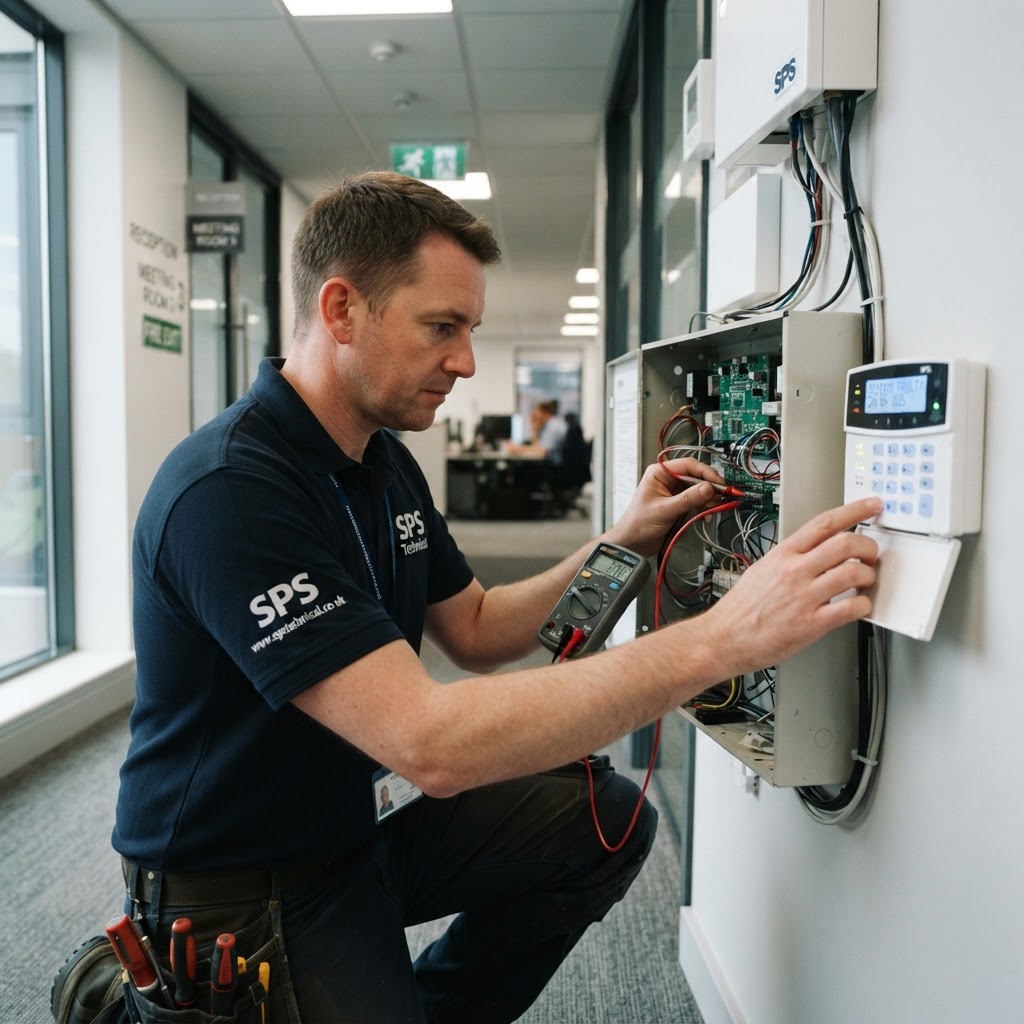
An intruder alarm fault is easy to ignore when the building is occupied.
At closing time, it can become an immediate security problem.
A keypad showing a fault, a detector that repeatedly activates, failed signalling or a system that will not set can leave a business uncertain about whether its premises are properly protected.
The first objective should not be to silence the warning and hope it disappears.
It should be to establish:
What has failed → What protection remains → What immediate action is required → How the fault will be rectified
For facilities managers, the difference between a minor device fault and a loss of critical protection matters.
Important: Do not open control equipment, defeat detection or attempt electrical/security-system repairs unless you are competent and authorised to do so. Where a monitored or police-response system is involved, changes can also affect signalling and response arrangements.
What counts as an intruder alarm fault?
Commercial alarm systems can report many different conditions.
Common examples include:
- detector faults;
- tamper conditions;
- mains failure;
- standby battery faults;
- communication/signalling faults;
- network or IP communication issues;
- wireless device faults;
- low batteries;
- bell or sounder faults;
- damaged cabling;
- door contact faults;
- user-code or setting problems;
- repeated false activations; and
- control-panel faults.
Not every warning means the entire alarm has failed.
Equally, a system that appears normal at the keypad may have a signalling or device problem that reduces protection.
What should a business do when an alarm develops a fault?
Start with the information available to the authorised user.
1. Read the display
Record the exact fault message rather than simply reporting "the alarm is broken".
2. Check the log where authorised
The event history may show when the problem began and whether it is recurring.
3. Consider what changed
Recent building work, power interruptions, network changes, damaged doors or equipment moves can all be relevant.
4. Contact the maintenance provider
Give them the exact message, affected area, time of occurrence and whether the building can still be secured.
5. Assess temporary security
If protection is materially reduced, the business may need interim measures until the system is restored.
These might include additional physical checks, keyholding response, guarding or other proportionate arrangements depending on risk.
When is an intruder alarm repair an emergency?
An emergency is not defined only by the appearance of a fault symbol.
The impact matters.
A repair may be particularly urgent where:
- the system cannot be set;
- a critical area is unprotected;
- alarm signalling has failed;
- a monitored system cannot communicate;
- the external sounder or key system component has failed;
- repeated activations are disrupting operations;
- the fault affects insurance requirements;
- police-response arrangements may be affected; or
- the premises will shortly be left unattended.
A single non-critical device fault in an occupied building may be managed differently from a complete failure immediately before a long closure.
Good maintenance arrangements therefore combine technical severity with operational risk.
Why won't my business alarm set?
A system may refuse to set because it detects an unresolved condition.
Examples can include:
- an open protected door;
- movement in an area;
- a detector fault;
- tamper condition;
- communication fault;
- damaged device;
- configuration issue; or
- another condition programmed to prevent setting.
Do not routinely bypass faults merely to get the building locked.
An authorised engineer or trained system user should establish what the warning means and whether any temporary isolation is permitted and appropriate.
Signalling faults deserve particular attention
A monitored alarm relies on more than local detection.
The chain can include:
Detector → Control equipment → Signalling path → Alarm Receiving Centre → Agreed response
A premises may still have local detection while losing the ability to transmit an alarm externally.
That can fundamentally change the security outcome.
Where signalling is affected, establish:
- whether the receiving centre is still receiving signals;
- whether one or more communication paths are affected;
- whether the issue is local, network-related or external;
- what temporary arrangements apply; and
- whether insurer or police-response requirements are relevant.
What causes repeated false alarms?
Repeated unwanted activations should be investigated rather than treated as normal.
Potential causes can include:
- incorrect detector selection;
- environmental conditions;
- damaged equipment;
- loose contacts;
- poorly fitting doors;
- insects or contamination;
- user error;
- incorrect setting procedures;
- building alterations;
- power problems; and
- ageing components.
The correct response is diagnosis, not automatically replacing the detector that happened to report the event.
The wider system and environment should be considered.
Why planned intruder alarm maintenance matters
Planned maintenance is intended to identify problems before they become emergency failures.
Depending on the system and applicable requirements, servicing can include inspection and testing of areas such as:
- control equipment;
- detection devices;
- warning devices;
- power supplies;
- standby batteries;
- tamper protection;
- signalling;
- event records;
- setting/unsetting operation; and
- system documentation.
The maintenance regime should reflect the system, risk, standards, insurer requirements and monitoring/police-response arrangements.
Maintenance is also about change
Commercial buildings rarely remain exactly as they were when an alarm was installed.
Businesses:
- build partitions;
- move racking;
- alter entrances;
- change operating hours;
- install machinery;
- create new high-value areas;
- extend buildings; and
- change how rooms are used.
A detector that was correctly positioned five years ago may no longer protect the intended risk effectively.
Maintenance visits provide an opportunity to ask whether the security requirement has changed, not just whether devices still activate.
SPS Technical view: a service visit should look beyond the fault
Repairing the immediate problem is important, but a useful engineer also asks why it happened and whether the system still suits the premises.
Repeatedly repairing an obsolete or badly configured system can cost more than addressing the underlying issue.
Repair or replace?
A fault does not automatically mean a new system is required.
A technical assessment can classify equipment as:
Retain → Repair → Upgrade → Replace
Repair may make sense where:
- the platform remains supported;
- parts are available;
- the design remains suitable;
- the fault is isolated; and
- ongoing maintenance is practical.
Upgrade or replacement may become more sensible where:
- equipment is obsolete;
- parts are unavailable;
- failures are recurring;
- signalling no longer meets requirements;
- expansion is difficult;
- the building has changed substantially; or
- lifecycle costs are increasing.
Facilities managers should ask for the reason behind a replacement recommendation.
Can another company repair my existing alarm?
Often an existing commercial system can be assessed for takeover by another competent provider, but this depends on the platform and circumstances.
A takeover survey can review:
- panel and software version;
- detector estate;
- system grade where applicable;
- signalling;
- monitoring;
- maintenance history;
- engineer access;
- documentation;
- open faults;
- police-response/URN status where applicable;
- insurer requirements; and
- equipment support.
Changing maintenance provider should be planned carefully where monitoring or police response is involved.
Do not cancel existing arrangements before understanding the consequences.
What information helps an engineer diagnose a fault?
Before calling, gather what you safely can:
- site name and address;
- panel make/model if known;
- exact display message;
- time the fault appeared;
- affected area/device;
- whether the alarm can set;
- whether monitoring has contacted you;
- recent power/network/building work;
- whether the fault is intermittent;
- previous similar incidents; and
- site access/contact details.
Good information can speed diagnosis and help determine the right response.
Alarm maintenance records
Keep records of:
- service visits;
- faults;
- callouts;
- parts replaced;
- recurring issues;
- false alarms;
- system changes;
- signalling changes;
- monitoring details; and
- recommendations.
Across a multi-site estate, this data becomes valuable.
It can reveal:
- recurring equipment failures;
- sites generating disproportionate callouts;
- obsolete platforms;
- battery replacement trends;
- false-alarm hotspots; and
- where capital investment should be prioritised.
Maintenance data should support asset planning, not disappear into individual engineer worksheets.
Cyber and network considerations
Modern security systems may use IP networks, apps, cloud services or remote support.
A fault can therefore originate outside the traditional alarm panel.
Where systems are network-connected, facilities and IT teams may need to coordinate around:
- network changes;
- routers/firewalls;
- IP addressing;
- internet availability;
- credentials;
- remote access;
- software/firmware support; and
- cybersecurity.
Security equipment should not be connected or exposed to networks without appropriate controls.
Emergency repair checklist
If a commercial intruder alarm develops a fault:
- Record the exact fault message
- Establish whether the system can still set
- Identify affected areas if known
- Check whether signalling remains operational
- Contact the authorised maintenance provider
- Avoid unauthorised bypasses or repairs
- Assess temporary security requirements
- Consider insurer/police-response implications
- Record the incident and repair
- Investigate repeated faults
- Review whether obsolete equipment needs lifecycle planning
Commercial intruder alarm repair across Yorkshire, Lincolnshire and the Humber
SPS Technical supports businesses with commercial intruder alarm maintenance, fault diagnosis, repairs, upgrades and system takeovers across Yorkshire, Lincolnshire and the Humber, including Hull, Grimsby, Lincoln, Sheffield and South Yorkshire.
Where an existing system is causing repeated problems, the objective should not automatically be to replace everything.
A technical review can establish what remains serviceable, what requires repair and whether a phased upgrade offers better long-term value.
If your commercial intruder alarm has developed a fault or your current system is becoming unreliable, SPS Technical can review the existing installation and recommend the appropriate next step.
Frequently asked questions
Why is my intruder alarm showing a fault?
The cause can range from a detector or battery problem to tamper, power, communication or signalling faults. Record the exact message and contact your maintenance provider rather than assuming the whole system has failed.
Can I still set an alarm with a fault?
That depends on the system and fault. Some conditions may prevent setting; others may allow authorised isolation. Do not routinely bypass a fault without understanding what protection is being lost.
How often should a commercial intruder alarm be maintained?
The appropriate maintenance frequency depends on the system, applicable standards, risk, monitoring, police-response and insurer requirements. Follow the documented maintenance regime for the specific installation.
Can SPS Technical take over an alarm installed by another company?
Many existing systems can be assessed for takeover, subject to equipment, access, documentation, certification and monitoring requirements. A takeover survey should establish the condition and any remedial work first.
Does an alarm signalling fault mean the detectors have stopped working?
Not necessarily. Local detection may continue while external alarm transmission is impaired. Because that changes the response outcome, signalling faults should be investigated promptly.